Belgian Brewery Builds a Pipeline, Sending Beer Lovers Into a Froth


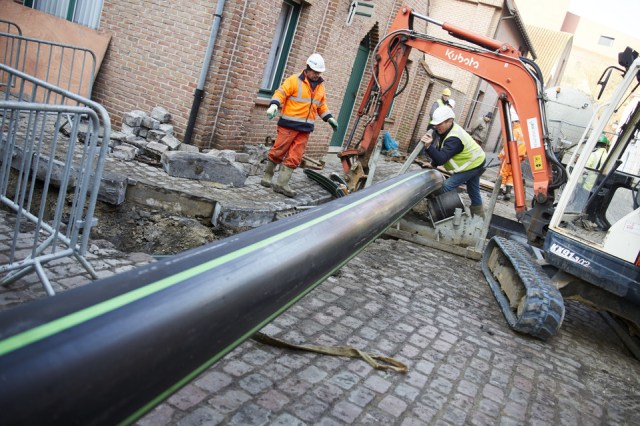
De Halve Maan brewery is running a pipeline for beer under the streets of Bruges, Belgium

By Matthias Verbergt

Xavier Vanneste, heir to a dynasty of beer brewers in Bruges Belgium, had a pipe dream.

When he woke up and looked out of his window one spring morning, he saw workers on the street laying underground utility cables in front of his house, situated on the same ancient square as the brewery he runs.

“I immediately realized this was the solution,” Mr. Vanneste said.

The brewery’s truck fleet had been bottling up the city’s narrow, cobblestone streets. Matters had been getting worse since 2010, when the brewery moved its bottling facility out of town.

His brain wave? A beer pipeline.

“It all started as a joke,” said Mr. Vanneste. “Nobody believed it was going to work.”

Four years later, the pipeline is just weeks away from completion. It stretches 2 miles from the brewery, De Halve Maan, or The Half Moon, in the city center to the bottling plant in an industrial area. It will be able to carry 1,500 gallons of beer an hour at 12 mph. Hundreds of truck trips a year will no longer be necessary.


De Halve Maan brewery’s beer hall in Bruges

Not long after the project was announced, the burghers of Bruges started dreaming of siphoning off personal supplies.

A local satirical TV show tricked people living near the route into believing that beer taps could be installed in their houses. Mr. Vanneste said it would be impossible to illegally tap into the polyethylene tubes, which he said are stronger than steel.

The citywide attention gave Mr. Vanneste another idea. He’d partly fund the €4 million ($4.5 million) investment by offering lifetime supplies of beer. Attracted by the liquid returns, brew-lovers sank some €300,000 into the project.

They were offered three options. The most expensive “gold” membership, which costs €7,500, entitles the holder to an 11-ounce bottle of Brugse Zot beer (retail price, €1.70) every day for life, along with 18 personalized glasses.

One of the 21 people who signed up for that was Philippe Le Loup, who runs a restaurant on the scenic Simon Stevin square, a few hundred yards from the pipeline. Mr. Le Loup, whose establishment serves about 1,850 gallons of Brugse Zot a year, said he would have preferred a direct tap into the pipeline. “It would have saved me a lot of keg-dragging,” he said.

Mr. Le Loup also bought bronze memberships, at €220 apiece, for each of his 12 employees, entitling them to a 25-ounce bottle of beer every year for life. “In total, I invested over €10,000,” said Mr. Le Loup, 35 years old, who was born in the city. “I calculated that if I pick up my free beers for 15 years, my investment will be paid back.” He said he plans to drink most of the beer himself.

“When I’m 50, I will make profit,” he said.

Last year, De Halve Maan exported about 200,000 liters of its most popular beers, Brugse Zot and Straffe Hendrik, to the U.S., double the 2014 figure.

Ronald Martin, a music teacher, home brewer and De Halve Maan fan in Buffalo, N.Y., was one of 76 foreigners to pitch in.

When he visited Bruges, he was convinced the pipeline was happening. He wanted to be the first American to take part. “When I walked into the brewery, the secretary had a phone call from another American,” Mr. Martin recalled. He immediately went to get cash and signed up.

“When you talk about a beer pipeline, everyone thinks you’re joking,” he said. “But it’s a serious thing.”

A few European sports arenas have aboveground pipelines. In Randers, Denmark, a pipeline under a street carries beer to some bars. The annual Oktoberfest beer festival in Munich, Germany, pipes beer to some tents. In Cleveland, Ohio, the Great Lakes Brewing Company moves beer through a pipe from its brewery to a bar across the street.

The city of Bruges, which last year attracted 6.6 million tourists, has long been looking for solutions to reduce traffic in its historic center—a Unesco World Heritage site known for its canals and medieval architecture.

“The pipeline is a breakthrough,” said Renaat Landuyt, mayor of Bruges, which was the economic capital of Northern Europe between 1200 and 1400.

Mr. Landuyt said he would even consider constructing pipelines for other goods, including chocolate, one of Belgium’s other precious commodities. “Everyone who proposes alternative means of transport is welcome here,” he said.

The centuries-old brewing company, the last one remaining in the city center, said its new pipeline wouldn’t affect the taste of its award-winning beers.

Most of the pipe runs about 6 feet underground, but in some spots it goes about 100 feet under. On a recent day, workers were digging holes, connecting tubes and replacing cobblestones on Zonnekemeers, a street near De Halve Maan, attracting the attention of many bystanders.

“The beer pipeline has become a sight,” said Alain De Pré, who oversees the construction of the pipeline. “People are taking more pictures of this than of the monuments around us.”

Sylvie Melkenbeek, a 78-year-old retiree, was enjoying her espresso on a sunlit terrace in front of De Halve Maan as horse carriages rolled by carrying tourists. Ms. Melkenbeek, whose last name literally translates as “stream of milk,” said she would much prefer a pipeline filled with coffee.

“I don’t like beer,” she said.

http://www.wsj.com/articles/brewery-builds-a-pipeline-sending-beer-lovers-into-a-froth-1462371340?mod=WSJ_article_EditorsPicks_4

Thanks to MJ Moore for bringing this to the attention of the It’s Interesting community.
World War One Wasteland – rare photographs

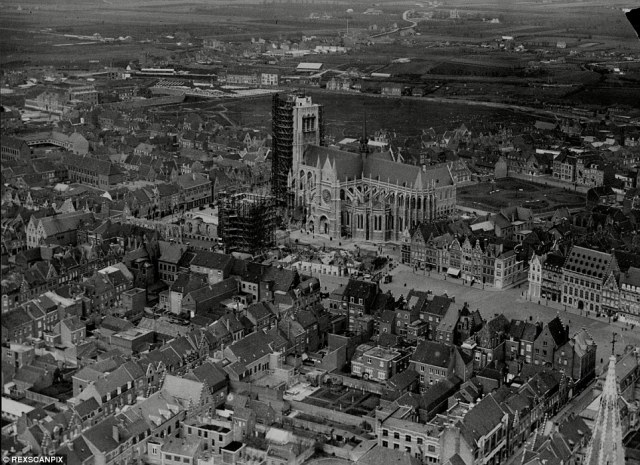
It could be the scene from a nuclear holocaust. A once-thriving city reduced to mere rubble, a 700-year-old cathedral barely left standing, trees that proudly lined an idyllic avenue torn to shreds. There’s barely anyone in sight. But the devastation wrought in these rare, haunting images was caused long before the atomic bomb came into existence.
It is the apocalyptic aftermath of dogged fighting along the Western Front during World War One when Allied and German forces tried to shell each other into submission with little success other than leaving a trail of utter carnage and killing millions.

The strategically important Belgian city of Ypres, which stood in the way of Germany’s planned sweep into France from the North, bore the brunt of the onslaught.
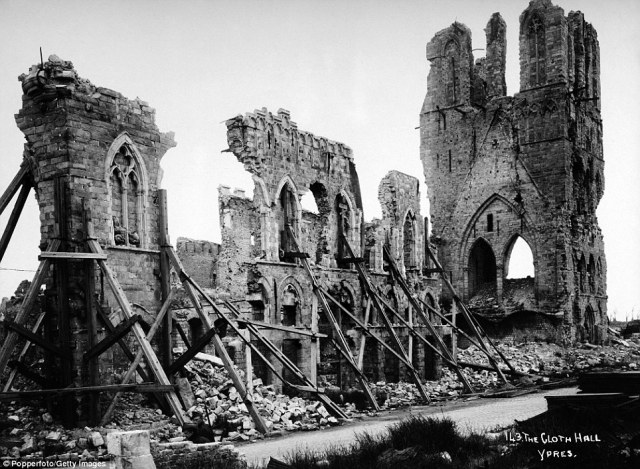
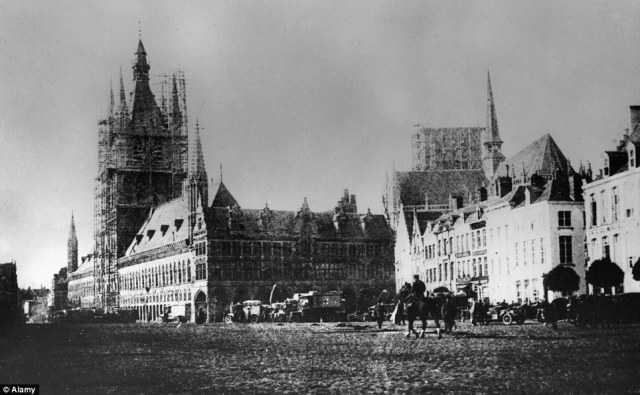
At its height, the city was a prosperous centre of trade in the cloth industry known throughout the world. After the war, it was unrecognizable. The Cloth Hall, which was one of the largest commercial buildings of the Middle Ages when it served as the city’s main market for the industry, was left looking like a medieval ruin.
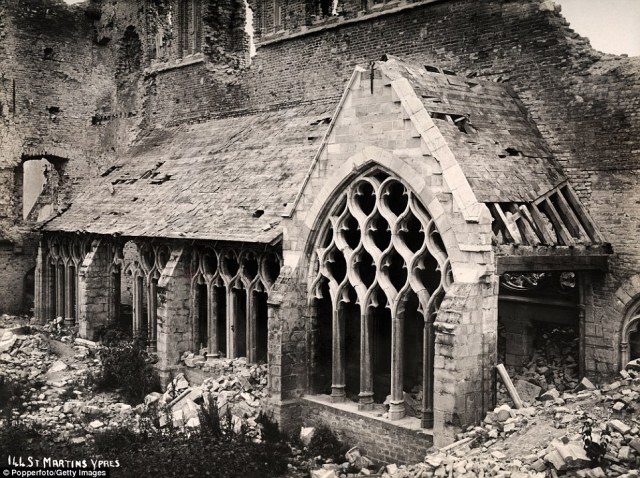
Its stunning cathedral, St Martin’s, fared little better

ww1
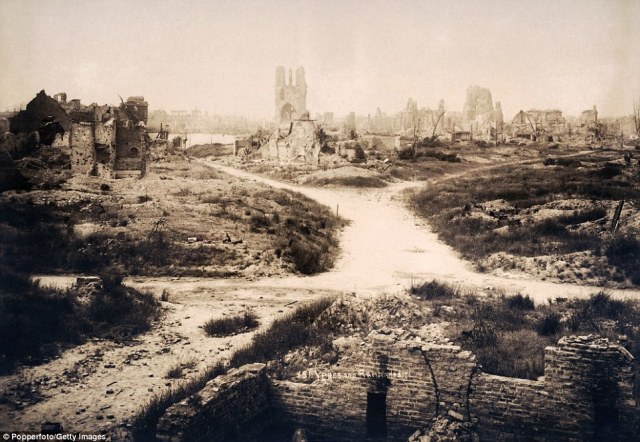
Apocalypse: This was all that remained of the Belgian town of Ypres in March 1919 after fierce fighting during World War One reduced it to mere rubble

ww2
In rehab: An aerial view of Ypres under construction in 1930 which gives an idea of how the city looked before it was bombarded during the Great War

ww3
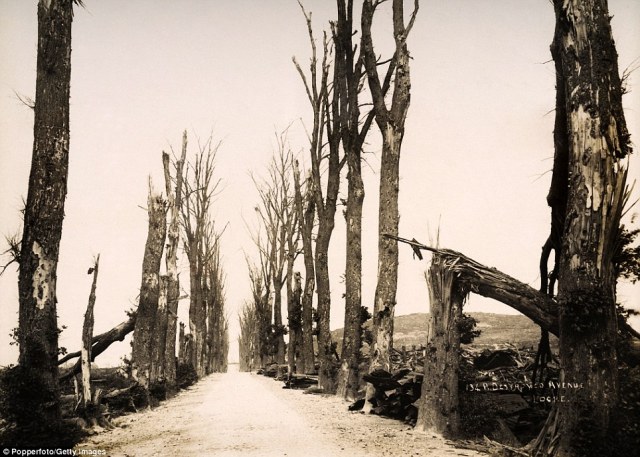
Felled: Trees along an avenue in Locre, Belgium, lie torn to shreds. These images are from a series documenting the devastation caused along the Western Front

ww4
Destroyed: The Hotel de Ville in Arras, Northern France, looks more like a medieval ruins after it was heavily shelled during World War One

ww5
Shaping nature: A huge bomb crater at Messines Ridge in Northern France, photographed circa March 1919, soon after the end of World War One

ww6
Reflected glory: A peaceful pond is what remains today of the craters made by massive mines on the Messines Ridge near Ypres. Their explosion was heard in London

ww7
Sorry sight: The Cloth Hall at Ypres, which was one of the largest commercial buildings of the Middle Ages when it served as the main market for the city’s cloth industry

ww8
Standing proud: How the Cloth Hall looked just before before the 1st bombardment by the Germans during the first battle of Ypres in October 1914

ww1
Doomsday: St Martin’s cathedral at Ypres, which was rebuilt using the original plans after the war. At 102 metres (335 ft), it is among the tallest buildings in Belgium

ww1
Devastation: St Martin’s Cathedral was the seat of the former diocese of Ypres from 1561 to 1801 and is still commonly referred to as such

ww1
How it looked before: The cathedral was rebuilt to the original Gothic design, with a spire added, as seen here in 1937

ww1
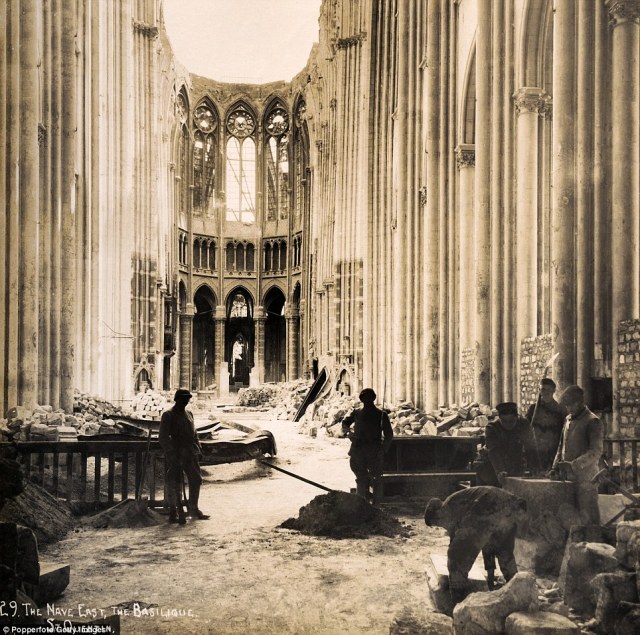
Clear-up effort: The East end of the Nave in the Basilique at Saint-Quentin in Northern France photographed soon after the end of World War One, circa March 1919

ww1
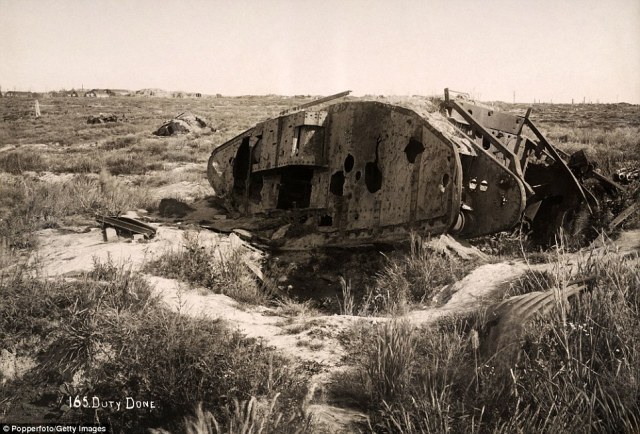
Shot to pieces: The wreckage of a tank. Some 7.5million men lost their lives on the Western Front during World War One

ww1
Forlorn: A little girl cuts a sorry figure surrounded by the ruined buildings in the French village of Neuve Eglise, which was heavily bombed

Read more: http://www.dailymail.co.uk/news/article-2282108/World-War-One-wasteland-Haunting-rare-images-apocalyptic-destruction-Western-Front.html#ixzz2LZUhxVxX

Thanks to Kebmodee for bringing this to the attention of the It’s Interesting community.
Car stuck at 125mph for an hour

shutterstock_124372423

It started with a trip to a supermarket. It ended with a high-speed chase, a frantic call to police, a highway-bound ballet, a border crossing, a ditch, and a guy who is very, very lucky to be alive.

Frank Lecerf, from his home in Pont-de-Metz, near the French city of Amiens, was making his weekly trip to the grocery store in his Renault Laguna. He was going 60 miles an hour when the car’s speed dial jammed. Lecerf tried to brake. Instead of slowing, though, the car sped up — with each tap on the brake leading to more acceleration. Eventually, the car reached a speed of 125 mph — and then remained stuck there. For an hour.

Lecerf’s general route was unexpectedly international, starting in France and ending in Belgium.

Lecerf, frantic, called the police from his car — and they sent an escort that The Guardian describes as “a platoon of police cars” to help him navigate a busy highway. (Lecerf stayed, appropriately, in the fast lane.) What resulted was a small miracle of technological coordination: Responding to emergency services’ advance warnings, three different toll booths raised their barriers as Lecerf approached. A police convoy ensured that roads were kept clear for the speeding car. Fellow drivers, obligingly, got out of the way. Emergency services patched Lecerf through to a Renault engineer who tried — though failed — to help Lecerf get the speeding car to slow down.

“My life flashed before me,” Lecerf later told Le Courrier Picard. “I just wanted it to stop.”

Finally, it did. The goal everyone had been working for, coordinating for — the speeding car running out of gas before its Newtonian nightmare ended in violence — was achieved. Lecerf’s car, finally out of fuel, came to rest in a ditch. He had driven from northern France and along the French coast up through Calais and Dunkirk, eventually crossing the border into Belgium. The little Renault had stopped, finally, in the town of Alveringem.

Before it did, though, Lecerf was stuck in his speeding car for an hour. (It’s unclear what, exactly, went wrong with the machine — though Lecerf’s upcoming lawsuit against Renault should help to figure that out.) The man and his vehicle and his communal, ad hoc escort ended up traveling more than 100 miles together before they got their Hollywood ending — an ending made possible not by individual heroics, but by collective effort.

http://www.theatlantic.com/technology/archive/2013/02/this-guys-car-got-stuck-at-125mph-for-an-hour/273140/?google_editors_picks=true

Thanks to Kebmodee for bringing this to the attention of the It’s Interesting community.
45 year old deaf Belgian twins win right to die after going blind

Verbessem-brothers_2451135b

The two men, 45, from the village of Putte, near the city of Mechelen outside Brussels, were both born deaf and sought euthanasia after finding that they would also soon go blind.

But their local hospital refused to end their lives by lethal injection because doctors there did not accept that the twins were suffering unbearable pain, the criteria for legal euthanasia under Belgian law.

“There is a law but that is clearly open to various interpretations. If any blind or deaf are allowed to euthanise, we are far from home. I do not think this was what the legislation meant by ‘unbearable suffering’,” doctors at the first hospital said.

Eventually the two brothers found doctors at Brussels University Hospital in Jette who accepted their argument that they were unable to bear the thought of not being able to see each other again.

The twin brothers had spent their entire lives together, sharing a flat and both working as cobblers.

Doctors “euthanised” the two men by lethal injection on December 14 last year and because the operation took place outside their local hospital each man was billed 180 euros for the cost of transporting their bodies home.

Neighbours and friends in the village of Putte said that the twins had to overcome strong resistance from their elderly parents to their demands for a mercy killing.

Dirk Verbessem, the older brother of Marc and Eddy, had defended the decision of his brothers to die.

“Many will wonder why my brothers have opted for euthanasia because there are plenty of deaf and blind that have a ‘normal’ life,” he said. “But my brothers trudged from one disease to another. They were really worn out.”

Mr Verbessem said his twin brothers were going blind with glaucoma and that Eddy had a deformed spine and had recently undergone heart surgery.

“The great fear that they would no longer be able to see, or hear, each other and the family was for my brothers unbearable,” he said.

Professor Wim Distelmans, the doctor that took the decision to “euthanise” the twins has also defended the decision. “It is certain that the twins meet all the conditions for euthanasia,” he said.

Chris Gastmans, professor of medical ethics at the Catholic University of Leuven, has criticised the decision and has concerns over the wider implications for the welfare of disabled people.

“I will not enter the legal discussion but I am left with questions,” he said.

“Is this the only humane response that we can offer in such situations? I feel uncomfortable here as ethicist. Today it seems that euthanasia is the only right way to end life. And I think that’s not a good thing. In a society as wealthy as ours, we must find another, caring way to deal with human frailty.”

Under Belgian law, euthanasia is allowed if the person wishing to end his life is able to make their wishes clear and a doctor judges that he is suffering unbearable pain.

The case is unusual because neither of the men was terminally ill nor suffering physical pain.

Just days after the twins were killed by doctors, Belgium’s ruling Socialists tabled a new legal amendment that will allow the euthanasia of children and Alzheimer’s sufferers.

If passed later this year, the new law will allow euthanasia to be “extended to minors if they are capable of discernment or affected by an incurable illness or suffering that we cannot alleviate”.

In 2002, Belgium was the second country in the world after the Netherlands to legalise euthanasia in but it currently only applies to people over the age of 18.

Some 1,133 cases of euthanasia – mostly for terminal cancer – were recorded in 2011, according to the last official figures.

In 2011, it emerged that people killed by euthanasia in Belgium are having their organs harvested for transplant surgery.

http://www.telegraph.co.uk/news/worldnews/europe/belgium/9800378/Belgian-twins-had-first-request-to-die-refused.html

Breakthrough in Augmented Reality Contact Lens

121205090931-large


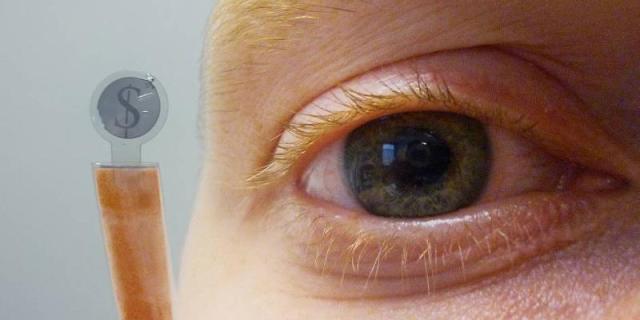
The Centre of Microsystems Technology (CMST), imec’s associated laboratory at Ghent University (Belgium), has developed an innovative spherical curved LCD display, which can be embedded in contact lenses. The first step toward fully pixilated contact lens displays, this achievement has potential wide-spread applications in medical and cosmetic domains.

Unlike LED-based contact lens displays, which are limited to a few small pixels, imec’s innovative LCD-based technology permits the use of the entire display surface. By adapting the patterning process of the conductive layer, this technology enables applications with a broad range of pixel number and sizes, such as a one pixel, fully covered contact lens acting as adaptable sunglasses, or a highly pixilated contact lens display.

The first prototype presented December 5 contains a patterned dollar sign, depicting the many cartoons that feature people or figures with dollars in their eyes. It can only display rudimentary patterns, similar to an electronic pocket calculator. In the future, the researchers envision fully autonomous electronic contact lenses embedded with this display. These next-generation solutions could be used for medical purposes, for example to control the light transmission toward the retina in case of a damaged iris, or for cosmetic purposes such as an iris with a tunable color. In the future, the display could also function as a head-up display, superimposing an image onto the user’s normal view. However, there are still hurdles to overcome for broader consumer and civilian implementation.

“Normally, flexible displays using liquid crystal cells are not designed to be formed into a new shape, especially not a spherical one. Thus, the main challenge was to create a very thin, spherically curved substrate with active layers that could withstand the extreme molding processes,” said Jelle De Smet, the main researcher on the project. “Moreover, since we had to use very thin polymer films, their influence on the smoothness of the display had to be studied in detail. By using new kinds of conductive polymers and integrating them into a smooth spherical cell, we were able to fabricate a new LCD-based contact lens display.”

Video: http://www.youtube.com/watch?v=-btRUzoKYEA

http://www.sciencedaily.com/releases/2012/12/121205090931.htm