
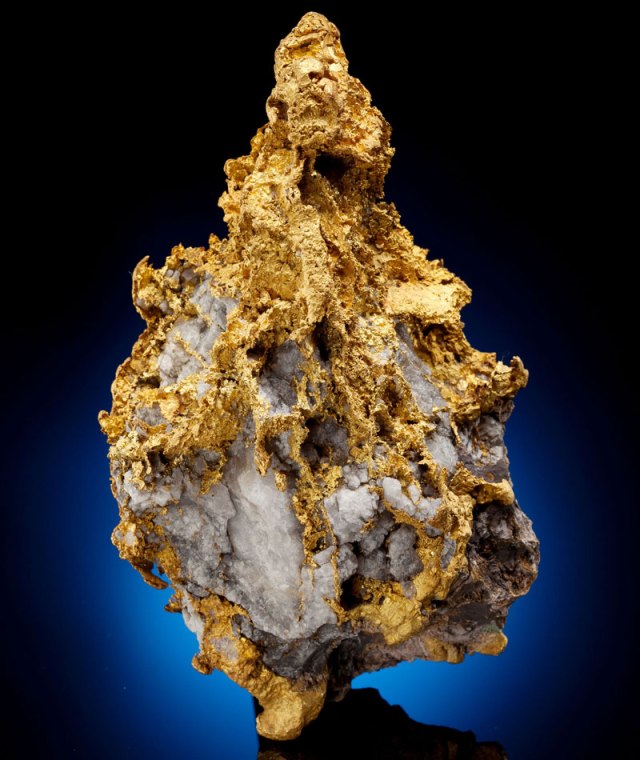
The tyrannosaur of the minerals, this gold nugget in quartz weighs more than 70 ounces (2 kilograms).
Earthquakes have the Midas touch, a new study claims.
Water in faults vaporizes during an earthquake, depositing gold, according to a model published in the March 17 issue of the journal Nature Geoscience. The model provides a quantitative mechanism for the link between gold and quartz seen in many of the world’s gold deposits, said Dion Weatherley, a geophysicist at the University of Queensland in Australia and lead author of the study.
When an earthquake strikes, it moves along a rupture in the ground — a fracture called a fault. Big faults can have many small fractures along their length, connected by jogs that appear as rectangular voids. Water often lubricates faults, filling in fractures and jogs.
About 6 miles (10 kilometers) below the surface, under incredible temperatures and pressures, the water carries high concentrations of carbon dioxide, silica and economically attractive elements like gold.
During an earthquake, the fault jog suddenly opens wider. It’s like pulling the lid off a pressure cooker: The water inside the void instantly vaporizes, flashing to steam and forcing silica, which forms the mineral quartz, and gold out of the fluids and onto nearby surfaces, suggest Weatherley and co-author Richard Henley, of the Australian National University in Canberra.
While scientists have long suspected that sudden pressure drops could account for the link between giant gold deposits and ancient faults, the study takes this idea to the extreme, said Jamie Wilkinson, a geochemist at Imperial College London in the United Kingdom, who was not involved in the study.
“To me, it seems pretty plausible. It’s something that people would probably want to model either experimentally or numerically in a bit more detail to see if it would actually work,” Wilkinson told OurAmazingPlanet.
Previously, scientists suspected fluids would effervesce, bubbling like an opened soda bottle, during earthquakes or other pressure changes. This would line underground pockets with gold. Others suggested minerals would simply accumulate slowly over time.
Weatherley said the amount of gold left behind after an earthquake is tiny, because underground fluids carry at most only one part per million of the precious element. But an earthquake zone like New Zealand’s Alpine Fault, one of the world’s fastest, could build a mineable deposit in 100,000 years, he said.
Surprisingly, the quartz doesn’t even have time to crystallize, the study indicates. Instead, the mineral comes out of the fluid in the form of nanoparticles, perhaps even making a gel-like substance on the fracture walls. The quartz nanoparticles then crystallize over time.
Even earthquakes smaller than magnitude 4.0, which may rattle nerves but rarely cause damage, can trigger flash vaporization, the study finds.
“Given that small-magnitude earthquakes are exceptionally frequent in fault systems, this process may be the primary driver for the formation of economic gold deposits,” Weatherley told OurAmazingPlanet.
Quartz-linked gold has sourced some famous deposits, such as the placer gold that sparked the 19th-century California and Klondike gold rushes. Both deposits had eroded from quartz veins upstream. Placer gold consists of particles, flakes and nuggets mixed in with sand and gravel in stream and river beds. Prospectors traced the gravels back to their sources, where hard-rock mining continues today.
But earthquakes aren’t the only cataclysmic source of gold. Volcanoes and their underground plumbing are just as prolific, if not more so, at producing the precious metal. While Weatherley and Henley suggest that a similar process could take place under volcanoes, Wilkinson, who studies volcano-linked gold, said that’s not the case.
“Beneath volcanoes, most of the gold is not precipitated in faults that are active during earthquakes,” Wilkinson said. “It’s a very different mechanism.”
Understanding how gold forms helps companies prospect for new mines. “This new knowledge on gold-deposit formation mechanisms may assist future gold exploration efforts,” Weatherley said.
In their quest for gold, humans have pulled more than 188,000 tons (171,000 metric tons) of the metal from the ground, exhausting easily accessed sources, according to the World Gold Council, an industry group.



 It's Interesting