
by Chris Packham , Medical Xpress
The brain’s white matter comprises areas of the central nervous system made up of myelinated axons. Its name is derived from the pale appearance of the lipids that comprise myelin. Myelin is a segmented sheath that insulates axons, ensuring the conduction of neural signals. The loss of myelin is documented in a number of neurodegenerative pathologies, including Alzheimer’s and Parkinson’s disease, and perhaps most notably, multiple sclerosis. As people age, demyelination becomes more likely.
The brain’s white matter comprises areas of the central nervous system made up of myelinated axons. Its name is derived from the pale appearance of the lipids that comprise myelin. Myelin is a segmented sheath that insulates axons, ensuring the conduction of neural signals. The loss of myelin is documented in a number of neurodegenerative pathologies, including Alzheimer’s and Parkinson’s disease, and perhaps most notably, multiple sclerosis. As people age, demyelination becomes more likely.
Previous investigations relying on conventional techniques were not able to isolate myelin from other brain matter; the new MRI technique employed here is more sensitive and specific to measuring myelin content in vivo. In fact, recent studies using multicomponent relaxometry MRI established correlations between local myelin water fraction with cerebral blood flow and motor function, both of which are influenced by cardiorespiratory fitness, which in turn motivated the NIH researchers to pursue the current study using the same technology.
Results
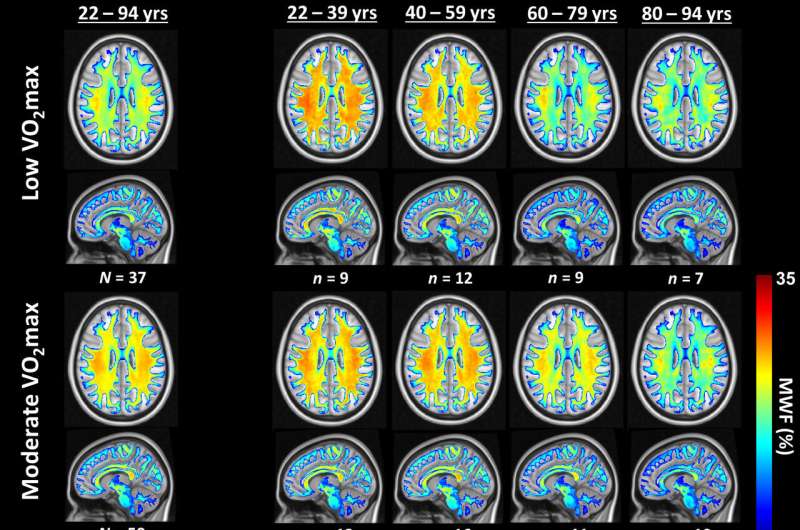
The researchers report that higher cardiorespiratory fitness correlated strongly with greater cerebral myelination. Further, higher cardiorespiratory fitness was associated with better myelin integrity, which was particularly notable in the middle-aged and older participants.
Notably, they found significant positive correlations between the two measures in the frontal lobes and white matter tracts—regions susceptible to early degeneration associated with neurological disorders at the onset of old age. They suggest that cardiorespiratory fitness is likely to be significantly protective for these sensitive brain regions, particularly among the subjects with lifelong fitness.
The researchers note that they were unable to establish a causal link between improved cardiorespiratory fitness and improved myelin integrity and that their results represent a correlation only.
“Nevertheless, our findings suggest that cardiorespiratory fitness is likely to be a valuable indicator of overall health and a potential target for interventions aimed at promoting brain health,” they write.
The study also notes the association of aerobic exercise with neuroprotective adaptations in the brain, as well as the upregulation of neurotrophins and brain-derived neurotrophic factor, which increases brain mitochondrial function. Declines in mitochondrial function have been previously associated with diseases resulting from demyelination.
The researchers suggest that future studies could use their work to study the relationship between physical fitness, brain health and myelin integrity to support brain aging and prevent neurological disorders.
They write, “Additionally, this work lays the foundation for further investigations into the potential therapeutic applications of improving cardiorespiratory fitness or myelination to promote healthy brain aging and combat age-related neurodegeneration, including in Alzheimer’s disease.”
More information: Evidence of association between higher cardiorespiratory fitness and higher cerebral myelination in aging. Proceedings of the National Academy of Sciences. DOI: 10.1073/pnas.2402813121
Journal information: Proceedings of the National Academy of Sciences
https://medicalxpress.com/news/2024-08-brain-links-cardiovascular-health.html
 It's Interesting