
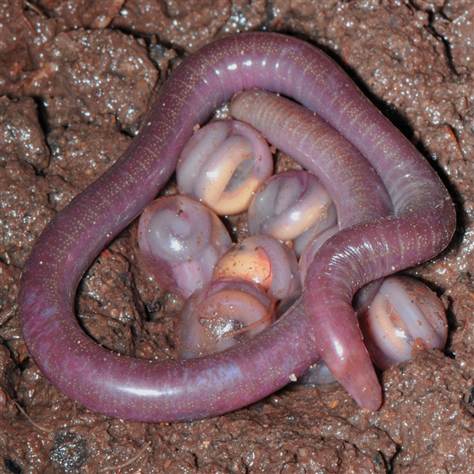
Since before the age of dinosaurs it has burrowed unbothered beneath the monsoon-soaked soils of remote northeast India — unknown to science and mistaken by villagers as a deadly, miniature snake.
But this legless amphibian’s time in obscurity has ended, thanks to an intrepid team of biologists led by University of Delhi professor Sathyabhama Das Biju. Over five years of digging through forest beds in the rain, the team has identified an entirely new family of amphibians — called chikilidae — endemic to the region but with ancient links to Africa.
Their discovery was published Wednesday in a journal of the Royal Society of London.
The chikilidae’s discovery, made along with co-researchers from London’s Natural History Museum and Vrije University in Brussels, brings the number of known caecilian families in the world to 10. Three are in India and others are spread across the tropics in Southeast Asia, Africa and South America. There is debate about the classifications, however, and some scientists count even fewer caecilian families.
Because they live hidden underground, and race off at the slightest vibration, much less is known about them than their more famous — and vocal — amphibious cousins, the frogs. Only 186 of the world’s known amphibious species are caecilians, compared with more than 6,000 frog species — a third of which are considered endangered or threatened.
Even people living in northeast Indians misunderstand the caecilians, and rare sightings can inspire terror and revulsion, with farmers and villagers chopping them in half out of the mistaken belief that they are poisonous snakes.
In fact, the chikilidae is harmless, and may even be the farmer’s best friend — feasting on worms and insects that might harm crops, and churning the soil as it moves underground.
Much remains to be discovered in further study, Biju said, as many questions remain about how the creatures live.
So far, Biju’s team has determined that an adult chikilidae will remain with its eggs until they hatch, forgoing food for some 50 days. When the eggs hatch, the young emerge as tiny adults and squirm away.
They grow to about 4 inches (10 centimeters), and can ram their hard skulls through some of the region’s tougher soils, shooting off quickly at the slightest vibration. “It’s like a rocket,” Biju said. “If you miss it the first try, you’ll never catch it again.”
A possibly superfluous set of eyes is shielded under a layer of skin, and may help the chikilidae gauge light from dark as in other caecilian species.
DNA testing suggests that the chikilidae’s closest relative is in Africa — with the two evolutionary paths splitting 140 million years ago when dinosaurs roamed what was then a southern supercontinent called Gondwana, since separated into today’s continents of Africa, Antarctica, Australia, South America and the Indian subcontinent.
http://www.msnbc.msn.com/id/46474242/ns/technology_and_science-science/
 It's Interesting