
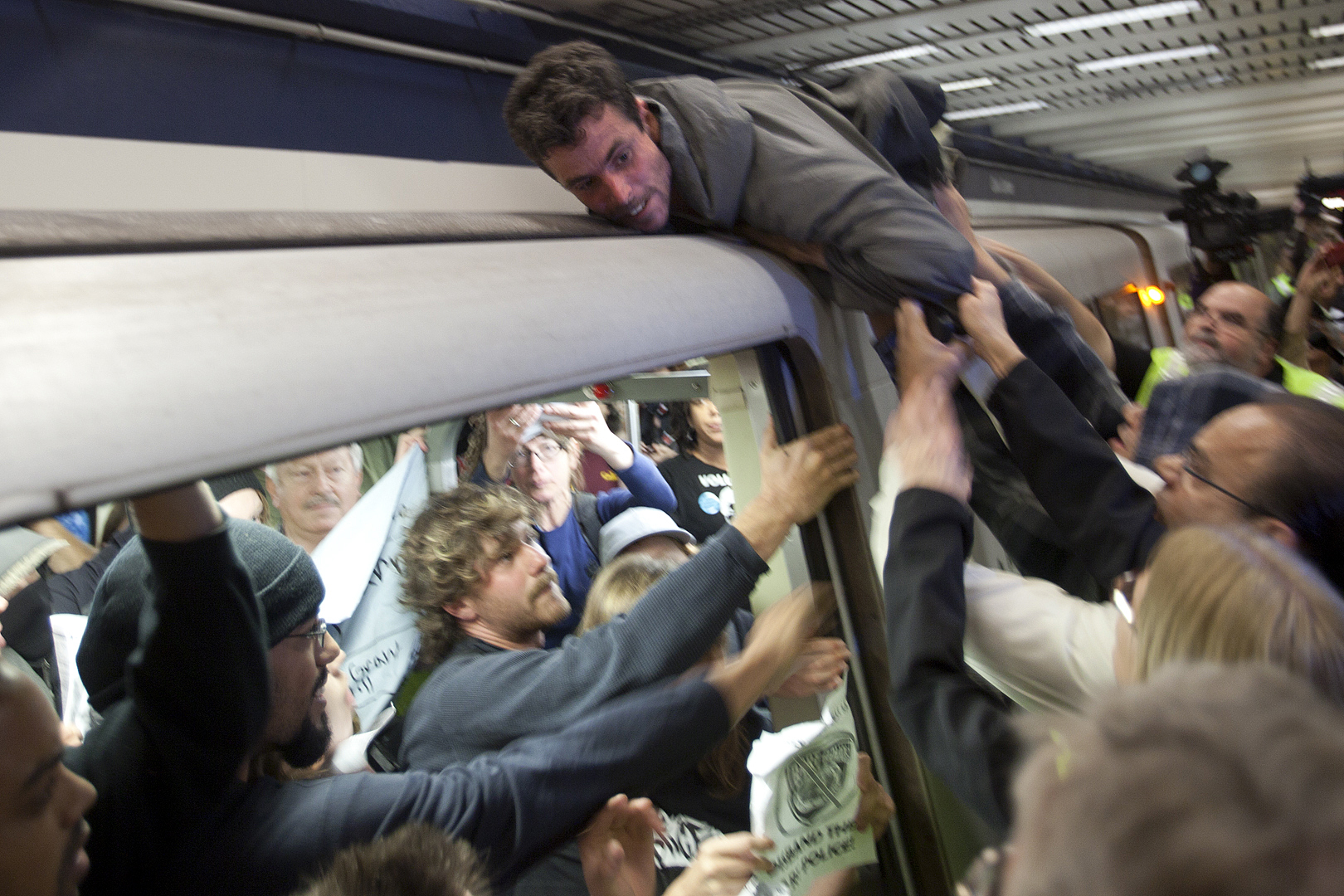
BART’s shut-off of subterranean cell phone service in its downtown San Francisco stations may have prevented a protest Thursday, but it sparked accusations Friday that the action stifled free speech and smacked of the kind of government intrusion employed by Middle East dictators.
“All over the world, people are using mobile devices to protest oppressive regimes, and governments are shutting down cell phone towers and the Internet to stop them,” said Michael Risher, a staff attorney for the American Civil Liberties Union of Northern California. “It’s outrageous that in San Francisco, BART is doing the same thing.”
BART officials acknowledged Friday afternoon that they had switched off the transit system’s underground cell phone network, which runs from Balboa Park Station through the Transbay Tube, from 4 to 7 p.m. Thursday to prevent protesters from coordinating plans to stop trains.
A cluster of groups under the “No Justice, No BART” banner said on websites that they planned to protest the fatal July 3 shooting of a knife-wielding man, Charles Blair Hill, by BART police. Protesters briefly shut down the Civic Center, Powell Street and 16th Street Mission stations July 11. Trains ran through the stations without stopping.
“Organizers planning to disrupt BART service stated they would use mobile devices to coordinate their disruptive activities and communicate about the location and number of BART Police,” the transit agency said. “A civil disturbance during commute times at busy downtown San Francisco stations could lead to platform overcrowding and unsafe conditions for BART customers, employees and demonstrators.”
Contrary to some speculative reports, BART did not jam wireless signals or ask cell phone providers to shut down towers near stations. BART owns and controls the wireless network strung through its subways, and BART police ordered it switched off, after receiving permission from BART interim General Manager Sherwood Wakeman, former general counsel for the transit district.
Benson Fairow, BART’s deputy police chief, said he decided to switch off the service out of concern that protesters on station platforms could clash with commuters, create panicked surges of passengers, and put themselves or others in the way of speeding trains or the high-voltage third rails.
“It was a recipe for disaster,” he said. “The fact that they started to conspire to commit illegal actions on the station platform was our concern. I asked myself: If my wife, mother or daughter was on that platform, would I want them to be in that situation?”
Civil libertarians questioned the constitutionality of BART’s decision and predicted legal action, or at least serious investigation by the Federal Communications Commission.
Read more: http://www.sfgate.com/cgi-bin/article.cgi?f=/c/a/2011/08/12/BAEU1KMS8U.DTL#ixzz1Uxu0YPTW
 It's Interesting