
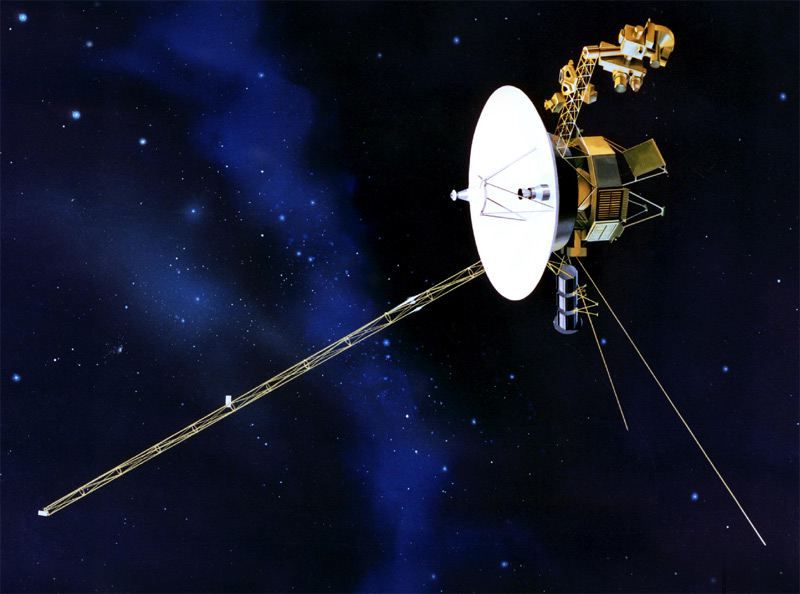
Launched in 1977, Voyager 1 photographed active volcanoes on the moon Io on its way past Jupiter in 1979.
In 1980, it confirmed the existence of three new moons orbiting Saturn.
In one of its final photographs, transmitted in 1990, Earth appears as a grainy speck bathed in the rainbow rays of the Sun.
Since then, NASA scientists have shut down six of its ten instruments, and it is so far away that transmissions now take more than 16 hours to reach Earth.
It is now traveling out of the heliosphere, the bubble of space filled by the Sun’s wind. In late 2004, Voyager 1 crossed the ‘termination shock’, the boundary beyond which the solar wind’s influence begins to wane. And this year researchers were expecting it to meet another boundary–one at which the solar wind sharply reverses direction, signaling the beginning of interstellar space.
Instead, Krimigis says, measurements of low-energy charged particles show that the solar wind has gradually slowed to zero and is mingling with interstellar gases. Theories failed to predict this mixed-up environment, and Krimigis says it may even be possible that this is, in fact, what interstellar space looks like. “We may have crossed and don’t know it, because nobody has a model that describes what we’re seeing,” he says.
 It's Interesting